Comparing LVT vs engineered wood? Explore durability, maintenance, Amtico, underfloor heating and the best flooring choices for different rooms.
Wood-effect LVT has become so convincing that choosing between it and engineered wood isn't always as straightforward as it sounds.
One gives you genuine timber, with the grain, variation and character that come from a natural material. The other gives you the look of wood with considerably less worry about muddy shoes, spills and everyday family life.
So, which would we choose?
It depends much more on the room and how you live than on which material is 'better'. If you're comparing LVT vs wood, we'd start with four things: where it's going, how much wear it needs to cope with, how much maintenance you're comfortable with and, importantly, how you want the floor to feel.
First, what are you actually walking on?
The biggest difference is simple: engineered wood contains a real timber surface; LVT doesn't.
Engineered wood flooring is constructed in layers, with a real hardwood surface over a more stable core. You still see the natural grain, knots and variation of timber, but its layered construction gives it greater stability than a traditional solid wood floor.
Luxury vinyl tile, or LVT, is a manufactured flooring product designed to recreate materials such as timber or stone. A protective wear layer sits over the decorative design, creating a floor that's durable and relatively straightforward to look after.
Modern LVT can be remarkably realistic, particularly when plank proportions, texture and laying pattern have been carefully chosen. But if having real timber beneath your feet matters to you, engineered wood still has something LVT can't completely reproduce.
Where LVT really earns its place
There are rooms where practicality has to carry quite a lot of weight.
Think of a kitchen on a Monday morning: breakfast being made, children coming through, perhaps a dog heading in from the garden and somebody inevitably spilling something.
This is where luxury vinyl flooring comes into its own.
Quality LVT is designed to cope well with busy everyday life and is easy to clean, making it a particularly useful option for kitchen flooring, hallways, utility rooms and other hardworking spaces. Depending on the particular product and installation system, it can also offer very good resistance to moisture.
And practical doesn't have to mean boring.
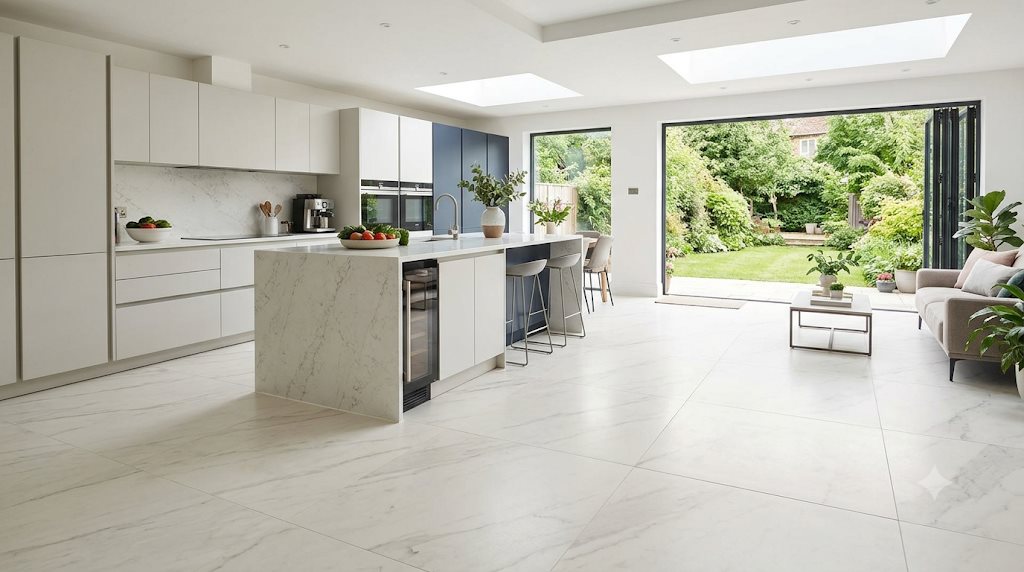
Wood effects can be laid in traditional planks, parquet or herringbone patterns, while stone and more decorative designs give you completely different possibilities. The floor can quietly sit behind the rest of the interior or become an important part of the design.
Why we'd still choose engineered wood
There is something lovely about a real timber floor.
No two boards are exactly the same. The colour and grain vary naturally, and the floor can develop character as it ages. For some homes, that slight imperfection is precisely the appeal.
This can make engineered wood flooring particularly beautiful through living rooms, dining spaces and bedrooms, but it can work elsewhere too when the conditions and product are suitable.
It does ask for a little more care. Water shouldn't be left sitting on the surface and scratches or changes in the timber are part of living with a natural material. Depending on the construction and thickness of the top layer, some engineered floors can also be refinished during their lifetime.
So the question becomes: do you want a floor that's as easy-going as possible, or is the natural character of real wood worth a little more looking after?
There isn't a wrong answer.
What about Amtico flooring?
For clients considering LVT, Amtico flooring is one of the ranges we work with at Tamaru.
What we particularly like is the amount of design freedom it gives us. Wood and stone effects are available alongside different plank and tile sizes, and patterns such as parquet allow the flooring to become part of the wider interior rather than simply the surface beneath it.
The different Amtico collections offer different designs, wear layers and specifications, so we'd look at where the flooring is going and what you need from it before deciding which collection is most suitable.
For busy kitchens and family spaces, the combination of durability, easy maintenance and design choice is a large part of LVT's appeal.
Don't underestimate the laying pattern
Sometimes the biggest difference isn't the material. It's what you do with it.
A wide engineered oak plank can give a room a completely different character from a narrow plank. Herringbone LVT can add detail to a hallway or kitchen without introducing another colour or material.
The direction matters too.
Running flooring through adjoining spaces can make them feel more connected, while changing the pattern can subtly define one area of an open-plan room. Borders and feature strips can introduce another layer of detail where appropriate.
It's one reason we'd always look at flooring as part of the whole interior rather than leaving it until everything else has been chosen.
And what about underfloor heating?
Both materials can potentially work as underfloor heating flooring, but the individual product specification and installation requirements matter.
Many LVT products are suitable for use with compatible underfloor heating systems. Engineered wood can be too, and the layered construction makes it better suited to temperature changes than many solid timber floors.
With real wood, however, temperature, moisture levels, subfloor preparation and the manufacturer's guidance all need to be considered carefully. This is one area where we'd choose the exact floor first and then make sure the heating and installation requirements work with it, rather than assuming any engineered board will be suitable.
So which would we put in a kitchen?
There isn't one answer for every kitchen.
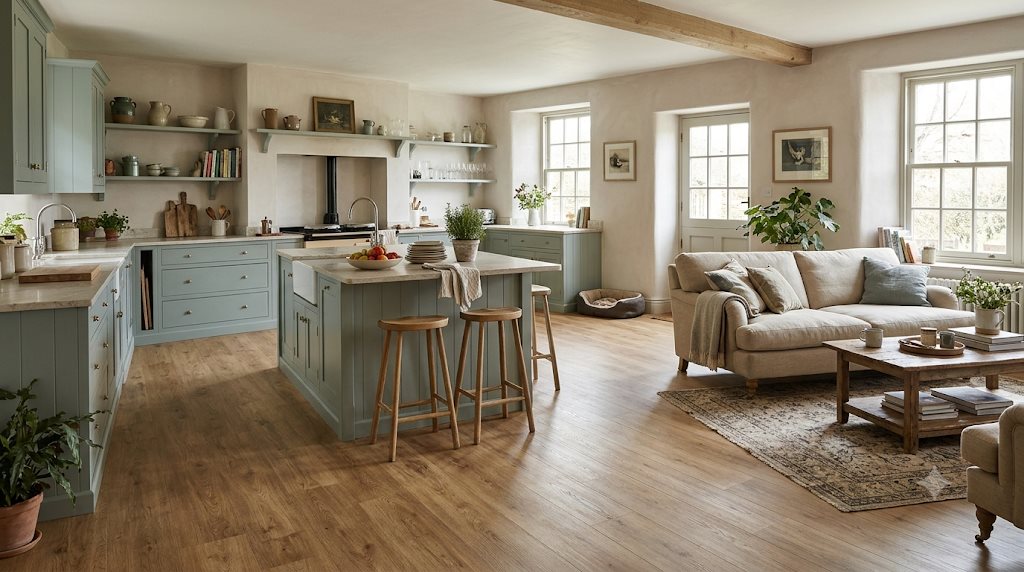
For a busy family home where easy cleaning and resistance to everyday spills are high on the list, we'd certainly consider LVT. It can give you the warmth of a timber look without quite the same level of concern around day-to-day wear.
But we wouldn't automatically rule out engineered wood. If having a genuine timber floor is important and you're comfortable with the additional care it requires, it can look beautiful running through a kitchen and adjoining living space.
This is where lifestyle matters just as much as aesthetics.
Look beyond the individual room
Flooring can have a surprisingly big influence on how connected a home feels.
If the kitchen opens into a dining or living area, continuing the same floor can help the spaces flow together. In other homes, a change of material or laying pattern can create a natural transition between rooms.
Colour matters too. A floor doesn't need to match the kitchen cabinetry or furniture, but the undertones need to sit comfortably together. Looking at samples alongside cabinet doors, worktops and other finishes can be much more useful than choosing the floor on its own.
For homeowners looking at luxury vinyl flooring in Leighton Buzzard, our Hockliffe showroom has Amtico samples that can be viewed alongside other interior finishes. We also supply Xylo engineered wood flooring, giving you the opportunity to compare the look and feel of both materials before making a decision.
We work with homeowners across Bedfordshire, Buckinghamshire and Hertfordshire, including Milton Keynes, Woburn, Dunstable, Tring and Aylesbury, as well as the villages surrounding our Hockliffe showroom.
Bring photographs, plans or samples from your project and we can look at how the flooring will work with the rest of your interior. Get in touch with our team to arrange a visit.