Porcelain or natural stone flooring? Compare maintenance, marble effects, large-format tiles and real stone to find the right finish for your home.
There is a reason natural stone floors are so appealing. Every piece is slightly different, with variations in colour, markings and texture that simply happen because the material came from the ground.
Then you look at porcelain.
Today's stone and marble effects can be incredibly convincing, with the added attraction of easier everyday care and a more consistent finish. Suddenly, choosing between the two becomes much less obvious.
So, when is real stone worth it, and when might porcelain actually be the better choice?
If you're comparing porcelain vs natural stone flooring, we'd look beyond appearance and think about the room, the amount of use it gets and how much maintenance you're comfortable with.
They may look similar, but they're very different materials
Porcelain is manufactured from refined clay and other materials, fired at very high temperatures to produce a dense, hard tile. Modern manufacturing can recreate everything from subtle limestone to richly veined marble, concrete and other natural finishes.
Natural stone flooring is exactly that: stone quarried from the earth and cut into tiles or slabs. Marble, limestone, travertine and slate all have their own characteristics, and even within the same stone you'll find natural differences from piece to piece.
That's part of the attraction.
With porcelain, you can usually achieve greater consistency. With natural stone, variation isn't a fault to eliminate; it's part of what you're choosing.
Why porcelain has become so convincing
One of the biggest changes in porcelain tiles is simply how good they can now look.
A well-designed marble-effect flooring can recreate veining, tonal changes and detail without asking you to live with some of the sensitivities of genuine marble. Limestone and travertine effects can be equally subtle.
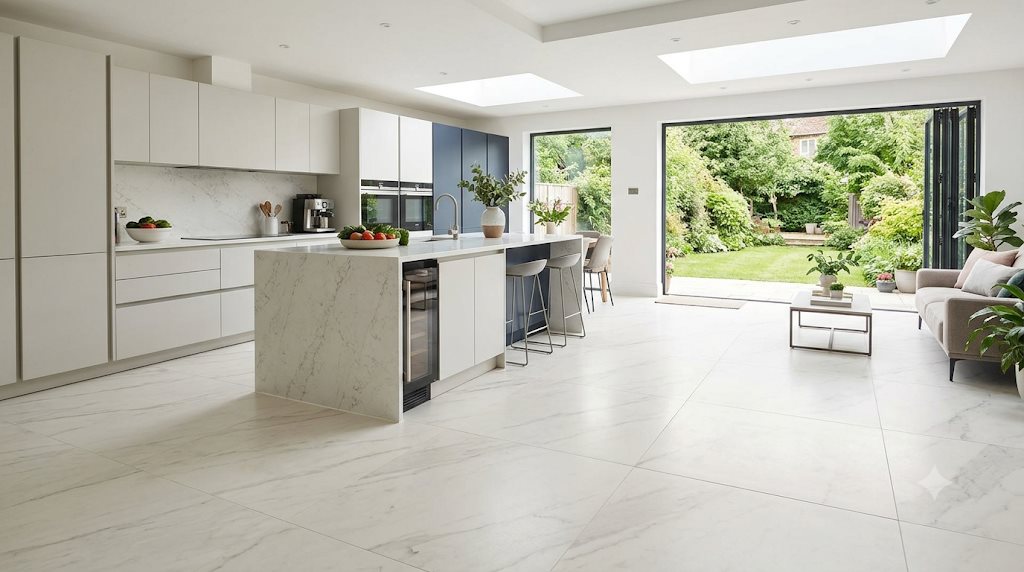
Larger tile sizes have opened up more possibilities too. Large format tiles can work particularly well across an open-plan kitchen or extension, where fewer grout lines can give the floor a quieter, more continuous appearance. They can also allow a strong marble pattern or stone effect to become more visible.
Porcelain is generally straightforward to maintain, which makes it appealing in busy family homes. But we'd still choose the exact product according to the room. Surface finish, slip resistance, tile thickness, grout and installation all matter, particularly in kitchens, bathrooms and entrances.
But real stone has something porcelain can't manufacture
However good the reproduction becomes, natural stone is still natural stone.
A limestone floor has tonal movement. Marble has veining that doesn't follow a repeated printed pattern. Travertine has its own texture and markings. Over time, a stone floor can also develop a patina that becomes part of the character of the room.
For some people, those differences are precisely why they'll choose it.
Natural stone can sit particularly beautifully in a home where the materials are intended to feel tactile and individual. It doesn't have to mean a grand marble entrance hall either. A softer limestone through a kitchen or aged-looking stone in a hallway can create a very different atmosphere.
The question is whether you love the natural variation enough to accept the additional care that can come with it.
How much maintenance does natural stone actually need?
This is where we'd be careful about general rules. Different stones need different levels of care. Marble and limestone, for example, can be more sensitive to spills and certain cleaning products than porcelain.
Depending on the stone you choose, floor tile sealing may be recommended to help protect it from staining. We'd always follow the care advice for that particular stone rather than assume every natural floor needs to be treated in exactly the same way.
Cleaning products matter too. Some everyday acidic or abrasive cleaners can damage certain natural stones, so stone floor maintenance may require a little more thought than looking after porcelain.
For somebody who wants a floor that's as uncomplicated as possible, that may be enough to steer the decision towards porcelain. For somebody who loves natural stone, it may be a perfectly reasonable trade-off.
Think about what happens in the kitchen
A kitchen floor has quite a demanding job. Chairs move across it. Food gets dropped. Drinks spill. Shoes come in from outside. If the kitchen connects to the garden, that can mean even more dirt and moisture travelling across the floor.
It's one reason porcelain makes such a strong option for kitchen floor tiles. You can achieve a stone or marble look while keeping everyday maintenance relatively simple.
Natural stone can absolutely be used in a kitchen too, but we'd choose the particular stone and finish with the realities of the room in mind. A floor that you're constantly worried about isn't much fun to live with, however beautiful it looked when it was first installed.
What about bathrooms?
Both materials can create a beautiful bathroom, but again we'd look at the specification rather than simply choosing on appearance.
With porcelain, the right surface finish and slip resistance are particularly important in wet areas. Natural stone needs to be selected with equal care, taking into account the stone itself, its finish and any recommended treatment.
This is also where flooring can become an important part of the bathroom design. Continuing a stone-effect porcelain from floor to wall can create a calm, almost seamless look, while genuine stone can introduce natural variation and texture.
And yes, both can work beautifully with underfloor heating
A tiled floor and underfloor heating are a lovely combination, particularly through kitchens, extensions and bathrooms.
Both porcelain and many natural stones conduct heat effectively, although the complete floor build-up, tile or stone thickness, heating system and installation all need to be considered.
It's worth planning this early. Flooring, heating and subfloor preparation are much easier to resolve before the finished floor level has already been decided.
If you're also weighing up wood-look options, our guide to LVT vs engineered wood flooring compares those two materials in the same way.
Sometimes you need to see them side by side
This is one decision that's difficult to make from an online photograph.
The subtle variation in natural stone, the texture of a porcelain surface and the scale of a marble pattern become much easier to understand when you have the material in front of you.
For homeowners considering porcelain vs stone flooring in Milton Keynes, our Hockliffe showroom is within easy reach. We work with homeowners across Beds, Bucks, Herts and the surrounding areas.
Rather than choosing a floor on its own, we'd look at how it works with the cabinetry, furniture, wall colours and any adjoining rooms. Bring photographs, plans or samples from your project and we can talk through the options with you. Get in touch with our team to arrange a visit.
Sometimes porcelain gives you exactly the look you want with easier everyday care. Other times, it's the natural variation and character of real stone that makes it worth choosing.